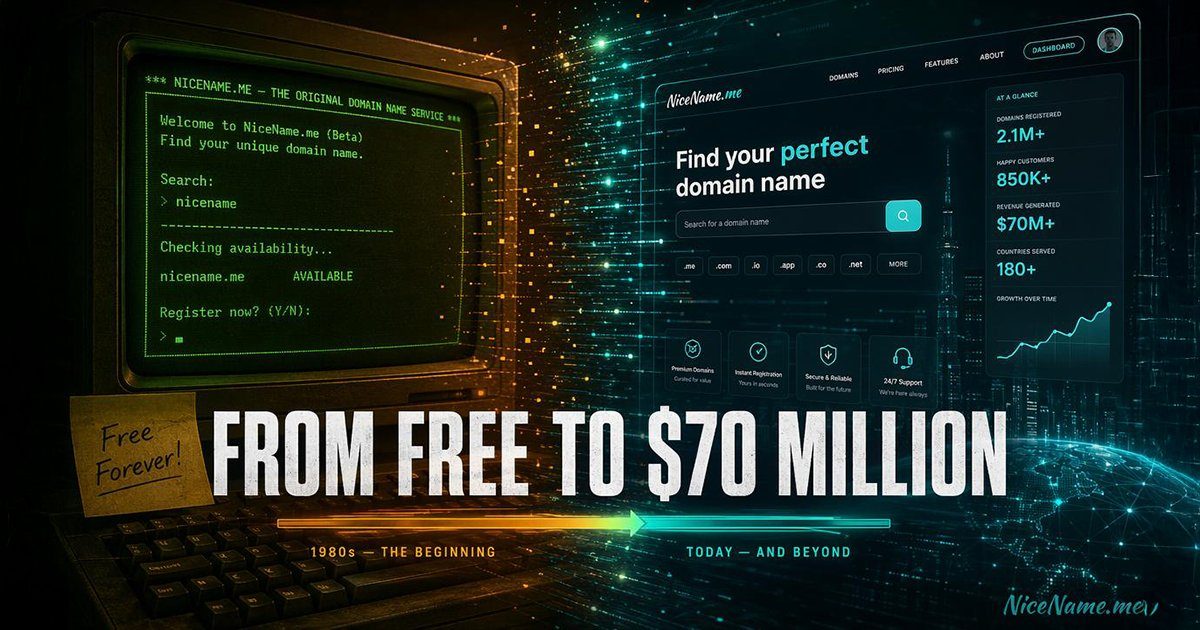
On January 1, 1985, the Domain Name System went live. On that same day, DARPA registered its own domains — darpa.mil, darpa.gov, and others — and a Scandinavian research network called NORDUnet registered nordu.net, making it the oldest domain name still active today. (It now serves as NORDUnet's corporate website — worth a visit if only for the bragging rights of seeing the internet's first address.)
Two and a half months later, on March 15, 1985, a company called Symbolics Inc. registered symbolics.com — the first .com domain in history. Symbolics was a spinoff from the MIT Artificial Intelligence Lab, building specialized computers optimized for the Lisp programming language. They weren't an "AI company" in the modern sense — no chatbots, no neural networks. They made hardware for researchers working on what was then a very different kind of artificial intelligence.
The registration was free. There was no website to fill out, no checkout cart. You emailed a form to a government contractor at the Stanford Research Institute and waited — days, sometimes weeks. Only five more .com domains were registered that entire year: bbn.com, think.com, mcc.com, dec.com, and northrop.com.
Today, symbolics.com has been turned into an interactive online museum of internet history, complete with a timeline explorer, daily quizzes, and a "digital assets" tracker showing record domain sales. We recommend visiting — it's a surprisingly well-made tribute to the internet's origins.
As of Q1 2026, there are 392.5 million registered domain names worldwide. The .com extension alone accounts for 163.6 million of them. And the most expensive domain sale in history — ai.com — closed in April 2025 for $70 million in cryptocurrency.
How did we get from six free registrations to a $70 million transaction in forty years?
What Is a Domain Name?
A domain name is a human-readable address that maps to a numerical IP address. When you type "google.com" into a browser, the Domain Name System (DNS) translates it into an IP address like 8.8.8.8 — a number your computer uses to locate the server. Think of it as a phone contact: you tap a name instead of dialing digits.
Every domain has two parts: the second-level domain (SLD) — the name you choose ("google," "amazon," "nicename") — and the top-level domain (TLD) — the extension after the dot (.com, .org, .ai). Together they form a unique address that can only belong to one owner at a time.
This uniqueness is the foundation of everything that follows. There can only be one amazon.com, one tesla.com, one ai.com. Scarcity creates value.
The Early Years: 1985–1995
Before DNS, every computer on ARPANET was identified by a numerical address maintained in a single text file called HOSTS.TXT. As the network grew, this system became unmanageable. In 1983–1984, computer scientists Paul Mockapetris and Jon Postel designed the Domain Name System as a scalable replacement. In January 1985, the first seven TLDs were created:
- .com (commercial) — intended for businesses
- .net (network) — for network infrastructure providers
- .org (organization) — for nonprofits and other organizations
- .edu (education) — for accredited US post-secondary institutions
- .gov (government) — for US government agencies
- .mil (military) — for US military
- .int (international) — for international treaty organizations
All seven still exist today. However, .edu, .gov, .mil, and .int are restricted — you can't register them publicly. .edu is limited to accredited US universities (managed by EDUCAUSE), .gov and .mil are controlled by the US government, and .int requires a treaty-level international organization. The "open" TLDs that anyone could register were .com, .net, and .org — and .com quickly became the default.
Domain registration was managed by the Stanford Research Institute's Network Information Center (SRI-NIC) and was completely free. By the end of 1985, only six .com domains existed. Growth was slow — by 1992, there were still fewer than 15,000 .com registrations. The internet was an academic and military tool, not a commercial platform.
Everything changed in 1993–1995. The Mosaic web browser (1993) and Netscape Navigator (1994) made the World Wide Web accessible to ordinary people. Businesses rushed to establish web presences. In 1995, Network Solutions received authority to begin charging for domain registrations — $100 per year for a .com. The gold rush had begun.
The Boom: 1995–2000
The late 1990s saw explosive growth in domain registrations and the birth of domain speculation. Business.com was purchased for $150,000 in 1997 and resold for $7.5 million in 1999. Companies hoarded domain names, sometimes registering thousands at a time.
In 1998, the Internet Corporation for Assigned Names and Numbers (ICANN) was created to oversee domain policy and open the registration market to competition. Before ICANN, Network Solutions had a monopoly. After ICANN, dozens of registrars entered the market, and prices dropped dramatically.
By 2000, over 20 million .com domains were registered.
Country-Code Domains Go Global
Alongside the original generic TLDs, country-code top-level domains (ccTLDs) were introduced starting in 1985–1986. Each country received a two-letter code based on the ISO 3166 standard: .us for the United States, .uk for the United Kingdom, .de for Germany, .cn for China, and so on. As of Q1 2026, there are 316 ccTLD extensions in the root zone, with 146.3 million total registrations.
Most ccTLDs serve their intended geographic purpose. But some small countries discovered that their two-letter codes had valuable alternative meanings — and turned them into significant revenue sources:
.ai (Anguilla) became the de facto domain for artificial intelligence companies. The tiny Caribbean island now earns roughly $3 million per month from .ai registrations — about a third of its entire government budget. The AI boom has turned an obscure country code into a goldmine.
.io (British Indian Ocean Territory) was adopted by tech startups as a trendy alternative to .com, partly because "I/O" means input/output in computing.
.co (Colombia) was marketed globally as a startup-friendly .com alternative. Companies like Twitter (t.co) and Google (g.co) use it for short URLs.
.tv (Tuvalu) was licensed to media and streaming companies. The Pacific island nation earns an estimated $7 million annually from its ccTLD.
.cc (Cocos Islands) initially gained popularity as an alternative to .com — the double letters suggested "Creative Commons," "Carbon Copy," or simply looked clean and symmetrical. It saw explosive growth in the late 2000s, but its reputation was badly damaged in 2011 when Google de-indexed the entire co.cc subdomain service (a free subdomain provider unrelated to .cc itself) due to massive spam abuse. The association unfairly tainted the .cc TLD for years. Since 2022–2023, .cc has been recovering as a budget-friendly option for personal projects, early-stage startups, and creative ventures — particularly attractive because registration and renewal costs remain low compared to .com or .io.
.so (Somalia) found an unexpected audience among tech professionals. The two letters read as "so" — a natural English word that works well in phrases and brand names — and the extension became associated with developer and tech communities, partly because "SO" echoes Stack Overflow. US and European tech startups use .so as a sleek, minimalist alternative.
New gTLDs: The Great Expansion
For the first two decades of the internet, the choice of TLDs was limited. If you wanted a generic domain, your options were essentially .com, .net, or .org (plus the restricted ones). This changed dramatically in 2012, when ICANN launched the New gTLD Program, allowing organizations to apply for entirely new extensions.
Over 1,000 new TLDs entered the market: .tech, .app, .store, .xyz, .club, .shop, .online, .site, and many more. Some brands even registered their own TLDs (.google, .amazon, .apple). As of Q1 2026, new gTLDs account for 49.6 million registrations — a 31.3% increase year-over-year, making them the fastest-growing segment.
But there's a catch: renewal rates for new gTLDs are just 30.9%, compared to 76.3% for .com. This means roughly seven out of ten new-gTLD registrations are abandoned after the first year — often because they were registered at promotional prices under $1 and never seriously used. .com owners, by contrast, renew three out of four times. This retention gap tells you a lot about which extensions people actually build businesses on.
The original generic TLDs (.com, .net, .org) are now called "legacy gTLDs" to distinguish them from the new wave. Together with .com and .net's 176.1 million registrations, legacy gTLDs still dominate the market — but the new extensions are growing fast.
How new TLDs are created: Any organization can apply to ICANN to operate a new TLD, but the process is expensive (application fee was $185,000 in the first round) and complex. The applicant becomes the registry operator — they set the rules, pricing, and policies for their extension. Registry operators can set registry premiums, charging more for desirable words within their TLD. The price differences can be dramatic — and they vary significantly between registrars.
Take .biz as an example. A standard .biz domain costs a few euros per year. But a short premium word like "1d.biz" costs €480 on Dynadot (generally the most affordable registrar for premium domains), $700 on Namecheap, or shows as "taken" on GoDaddy even though it's actually available as a registry premium elsewhere. A three-letter dictionary word like "vox.biz" jumps to €721 on Dynadot, $1,050 on Namecheap, or €980 on GoDaddy. And a strong keyword like "gin.biz" reaches €4,808 on Dynadot, $7,000 on Namecheap, or €6,092 on GoDaddy. Same domain, same registry premium — but the registrar markup can double the price.
Registry premiums also come with permanently higher renewal costs — "gin.biz" renews at €16.55/year on Dynadot versus €30.71/year on GoDaddy. This is different from aftermarket pricing, where a domain's cost reflects what a previous owner wants for it. Registry premiums are set by the TLD operator itself. They exist for many new gTLDs and some ccTLDs (.ai, .io), but notably not for .com — Verisign charges one uniform wholesale price for all .com domains.
ICANN is currently preparing a second round of new gTLD applications, expected to open in 2026.
The Top 10 TLDs in 2026
Based on the DNIB Q1 2026 report, the largest TLDs by registration count are:
- .com — 163.6 million (renewal rate ~76%)
- .cn (China) — largest ccTLD
- .de (Germany)
- .net — 12.4 million (renewal rate 80%)
- .org
- .uk (United Kingdom)
- .xyz — the largest new gTLD
- .ru (Russia)
- .top
- .nl (Netherlands)
The top 10 ccTLDs are: .cn, .de, .uk, .ru, .nl, .br (Brazil), .fr (France), .au (Australia), .in (India), and .eu.
(Source: DNIB.com Q1 2026 Quarterly Report)
The Most Expensive Domain Sales in History
Domain names are digital real estate — and like physical real estate, the best locations command extraordinary prices. Here are the top publicly confirmed all-cash domain sales:
| # | Domain | Price | Year | Venue |
|---|---|---|---|---|
| 1 | ai.com | $70,000,000 | 2025 | GetYourDomain |
| 2 | voice.com | $30,000,000 | 2019 | Private |
| 3 | chat.com | $15,500,000 | 2023 | Private |
| 4 | nfts.com | $15,000,000 | 2022 | Domainer.com |
| 5 | rocket.com | $14,000,000 | 2024 | Hilco Digital |
| 6 | sex.com | $14,000,000 | 2005 | Private |
| 7 | sex.com | $13,000,000 | 2010 | Sedo |
| 8 | crypto.com | $12,000,000 | 2018 | Private |
| 9 | club.com | $10,000,000 | 2025 | Hilco Digital |
| 10 | connect.com | $10,000,000 | 2022 | Private |
(Source: NameBio Top 100 Domain Sales. List limited to confirmed all-cash transactions.)
A few observations worth noting. Sex.com appears twice — sold in 2005 for $14 million, then again in 2010 for $13 million. Apparently, sex loses value over time, at least in the domain market. Meanwhile, the top spots increasingly belong to technology and communication: ai.com, voice.com, chat.com, crypto.com. It's almost poetic that human conversation and artificial intelligence have overtaken sex as the internet's most valuable real estate. What will be next?
The ai.com sale deserves special attention. The seller, Arsyan Ismail, acquired the domain in 2021 from a Kuwaiti domain holding company called Future Media Architects for approximately $11 million. He sold it in April 2025 for $70 million in cryptocurrency to Kris Marszalek, CEO of Crypto.com, who launched an agentic AI platform under the ai.com banner with a Super Bowl advertisement. Despite viral media claims that Ismail bought the domain "for $100 as a 10-year-old in 1993," investigative reporting established that the actual ownership chain was more complex and the $100 story could not be verified.
But it's not only .com that commands seven figures. Other TLDs have their own million-dollar club:
- bot.ai — $1,200,000 (2026, Sedo)
- kredit.de — $1,169,175 (2008, Sedo)
- cruises.co.uk / cruise.co.uk — $1,099,798 each (2008, Private)
- poker.org — $1,000,000 (2010, Sedo)
- sex.xxx — $3,000,000 (2014, ICM Registry)
And many high-value transactions remain confidential — private sales where neither price nor buyer is disclosed. The public record represents only the visible portion of the market.
The Daily Reality: What Most Domains Actually Sell For
The headline sales make for exciting reading, but they represent a tiny fraction of the market. On a typical day in 2026, hundreds of domains change hands — most for far more modest sums.
Looking at a single day of public sales data (May 3, 2026, with 771 recorded transactions), the picture is sobering. The top ~13% of sales (roughly 100 domains) sold for $1,000 or more. The vast majority — over 60% — sold for under $300. Names like "glambeautybarspa.com" and "annmargretperfume.com" changed hands for $305, while random letter combinations like "kyfsgs.com" went for $870 on Dynadot.
This matches what industry insiders will tell you: the bulk of the domain market operates in the $100–$500 range. The $1,000–$3,000 tier that industry reports often cite as "average" is misleading — it's skewed by a small number of premium sales pulling up the mean.
Registration Is Cheap. Good Names Are Not.
Today you can register a standard .com for under $10 per year. But there's a catch: the odds of finding a short, meaningful, memorable .com that hasn't already been registered are extremely low. With 163.6 million .com domains already taken, virtually every common English word, two-word combination, and popular phrase is claimed.
This is why the domain aftermarket exists. Domains have become independent digital assets — traded, invested in, and speculated on much like art, luxury goods, or real estate. Professional domain investors ("domainers") acquire portfolios of potentially valuable names, holding them for months or years until an end-user buyer appears.
But don't be fooled by the headline numbers. This is a highly speculative market. The normal sell-through rate for a domain portfolio is around 1.5–2% per year — meaning out of 100 domains, you might sell one or two annually, barely covering renewal costs. At 2–5% per year, it starts to resemble a real business. Most domain investors will tell you that patience is the single most important skill in the industry.
What determines whether a domain is worth $10 or $10,000 — or $10 million? That's a question big enough for its own article.
Domain Disputes: When Names Get Fought Over
Where there's valuable real estate, there are disputes. The Uniform Domain-Name Dispute-Resolution Policy (UDRP), created by ICANN in 1999, lets trademark holders challenge domain registrations they consider infringing. To succeed, they must prove the domain is confusingly similar to their trademark, the registrant has no legitimate interest in it, and it was registered in bad faith.
Perhaps the most famous domain dispute is Nissan Motor Co. v. Nissan Computer Corp. — an eight-year legal battle (1999–2007) over nissan.com. An Israeli-American entrepreneur named Uzi Nissan had registered the domain in 1994 for his computer business — "Nissan" being his actual family name. When the automaker demanded it, he refused. The case ultimately vindicated Uzi's rights, but the legal fight cost him nearly $3 million and consumed his life for a decade. He passed away in 2020. The case remains a landmark in law schools worldwide.
We'll cover the full Nissan story and other landmark domain disputes in a dedicated article — it deserves more space than we can give it here.
Meanwhile, domain purchases involving famous trademarks continue. Just recently, microsoftfoundry.com sold for $20,000 on Dynadot — despite "Microsoft" being one of the most protected brands in the world and the domain having zero Wayback Machine history. Whether this was a defensive buyback or a speculative gamble, the risks of registering domains containing famous brand names remain very real.
Domain Names by the Numbers (Q1 2026)
392.5 million — total registered domain names worldwide, up 6.5% year-over-year. The internet is still growing.
163.6 million — .com registrations alone, roughly 42% of all domains globally.
6 — the number of .com domains that existed at the end of 1985. It took until 1992 to reach 15,000. The 100 million milestone came in 2012.
$70 million — the highest confirmed domain sale ever (ai.com, 2025). Paid in cryptocurrency by the CEO of Crypto.com.
$3 million per month — what Anguilla earns from .ai domain registrations, funding roughly a third of the small island nation's government budget.
76.3% — .com and .net combined renewal rate (Q1 2026). For new gTLDs, it's just 30.9%. Three out of four .com owners keep paying. Seven out of ten new-gTLD owners don't.
1,593 — the number of TLD extensions in the IANA root database as of February 2026.
$0 — the cost of registering symbolics.com in 1985. Domain registration was free until 1995, when Network Solutions began charging $100/year.
(Sources: DNIB Q1 2026, IANA Root Zone Database, NameBio)
The Future of Domain Names
Domain names have survived every technology shift thrown at them — social media, app stores, voice search, blockchain naming systems. Each was supposed to make domains obsolete. None did.
The reason is simple: domain names remain the only universal, platform-independent digital identity you actually own. Your Instagram handle belongs to Meta. Your app store listing belongs to Apple or Google. Your domain name belongs to you.
The market is shifting, though. .com's growth has flattened — and for an understandable reason: after 163.6 million registrations, it's incredibly difficult to find a short, meaningful .com that isn't already taken. New gTLDs are growing at 31.3% annually. AI-related domains (.ai) saw registrations increase 78% in a single year. Blockchain-based naming systems like ENS (.eth) are emerging but remain niche.
For businesses and investors, the fundamental calculation hasn't changed since symbolics.com was registered: a good domain name is a scarce asset that gets more valuable as the internet grows. The difference is that in 1985, nobody knew it. Now everybody does — and the prices reflect that reality.
Curious What Your Domain Is Worth?
Get three realistic price estimates — Quick Sale, Realistic Market, and Ideal Buyer — powered by AI and real market data.
Free Domain Appraisal →Domain statistics sourced from DNIB Q1 2026 Quarterly Report (Verisign), IANA Root Zone Database, NameBio public sale records, and Wikipedia. All sale prices are publicly reported and confirmed figures unless otherwise noted. The ai.com ownership history is based on investigative reporting by DeeperInsights.com (February 2026).
Find Your Perfect Domain
Free three-tier appraisal — quick sale, realistic market, ideal buyer. No guesswork.
Try Free Appraisal Browse Premium Domains